
Wikipedia: Louis Hirsch Kauffman (born February 3, 1945) is an American mathematician, mathematical physicist, and professor of mathematics in the Department of Mathematics, Statistics, and Computer Science at the University of Illinois at Chicago. He does research in topology, knot theory, topological quantum field theory, quantum information theory, and diagrammatic and categorical mathematics. He is best known for the introduction and development of the bracket polynomial and the Kauffman polynomial.
Boundary Language regards Kauffman as the principal advocate and guide for George Spencer-Brown’s Laws of Form (1969). This non-numerical calculus offers insights into issues of self-reference and non-orientation, key to Jacques Lacan’s topology and “pre-Boolean” logic. For those who advocate extending Lacan’s work to quantum mechanics, Kauffman and Spencer-Brown would seem to be the most advisable route. Proponents of Radical Ontology (Object-oriented Ontology) have cited Spencer-Brown’s calculus indirectly, through the work of Niklas Luhmann. Levy Bryant has followed Luhmann in asserting that “distinction” (cf. between the observer and the observed) necessarily precedes “indication” (cf. a declaration of the contents of the observer’s frame). But, Kauffman corrects this view, citing Spencer-Brown’s explicit statement that distinction and indication are simultaneous and self-referencing.† This simultaneity is essential in showing how, in Lacan’s topology and knot theory, constructs such as the perspective hinge, Borromeo knot, the “true hole,” and the Euler circle’s configuration known as “union without intersection” really work.
This collection is only minimally representative and is offered as a first step. Much of Kauffman’s work is in the public domain and easily accessible.
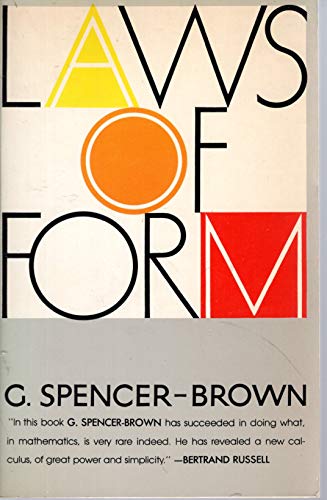
This paper is about G. Spencer-Brown’s “Laws of Form” [LOF, SB] and its ramifications. Laws of Form is an approach to mathematics, and to epistemology, that begins and ends with the notion of a distinction. Nothing could be simpler. A distinction is seen to cleave a domain. A distinction makes a distinction. Spencer-Brown [LOF] says “We take the form of distinction for the form.” There is a circularity in bringing into words what is quite clear without them. And yet it is in the bringing forth into formalisms that mathematics is articulated and universes of discourse come into being. The elusive beginning, before there was a difference, is the eye of the storm, the calm center from which these musings spring.
Self-reference and Recursive Forms
The purpose of this essay is to sketch a picture of the connections between the concept self-reference and important aspects of mathematical and cybernetic thinking. In order to accomplish this task, we begin with a very simple discussion of the meaning of self-reference and then let this unfold into many ideas. Not surprisingly, we encounter wholes and parts, distinctions, pointers and indications, local-global, circulation, feed- back, recursion, invariance, self-similarity, re-entry of forms, paradox, and strange loops. But we also find topology, knots and weaves, fractal and recursive forms, infinity, curvature and imaginary numbers! A panoply of fundamental mathematical and physical ideas relating directly to the central turn of self-reference.
This paper studies a mathematical model for automata as direct abstractions of digital circuitry. We give a rigorous model for distributed delays in terms of a precedence order of operations. The model is applied to automata that arise in the study of topological invariants of knots in three dimensional space and to digital design.
Imaginary Values in Mathematical Logic
We discuss the relationship of G. Spencer-Brown’s Laws of Form with multiple-valued The calculus of indications is presented as a diagrammatic formal system. This leads to domains and values by allowing infinite and self-referential expressions that extend the system. We reformulate the Varela/Kauffman calculi for self- reference, and give a new completeness proof for the corresponding three-valued algebra (CSR).
George Spencer-Brown’s work Laws of Form makes a new beginning in mathematics, logic and epistemology by starting with the idea of distinction and the idea of indication. A calculus with two values ensues and from this beginning a new kind of value beyond the True and the False comes forth that can be called imaginary. This paper is an explication of specific aspects of imaginary values in relation to the original calculus of indications of Spencer-Brown. We consider two new arithmetics that extend this calculus by using concepts of almost unmarked and almost marked in an extended hierarchy of unmarked < almost unmarked < almost marked < marked. This aspect of extra values leads to the notions of Heyting and Co-Heyting algebras. We explain these relationships via a topological calculus of boundaries. We later review calculi involving the re-entering mark and discuss a new way to relate the square root of negation to laws of form via a four-fold operator and its relationship with the work of Art Collings. The paper ends with a short exposition of fractal structures in relation to the re-entering mark. All these extensions of laws of form are seen as examples of how mathematics becomes a new vehicle for reason and understanding.
Virtual logic is not logic, nor is it the actual subject matter of the mathematics, physics or cybernetics in which it may appear to be embedded. Virtual logic lives in the boundary between syntax and semantics. It is the pivot that allows us to move from one world of ideas to another. This paper studies the virtuality of ordinary and mathematical logic. Through examples it is shown how ‘ordinary reason’ is itself a paradox. Reason itself is not at all reasonable! Each new mathematical construction, each new distinction, each theorem is an act of creation. Ordinary reason itself is virtual. The credo of clarity is not ordinary. It goes beyond reason into a world of beauty, communication and possibility.
Reflexivity and Eigenform: The Shape of Process
This paper discusses the concept of a reflexive domain, an arena where the apparent objects as entities of the domain are actually processes and transformations of the domain as a whole. Human actions in the world partake of the patterns of reflexivity, and the productions of human beings, including science and mathematics, can be seen in this light.
†See: Levi Bryant, ‘Introduction: Towards a Finally Subjectless Object,’ in The Democracy of Objects (Ann Arbor, MI: Open Humanities Press, 2011). Refutation of this can be found in Don Kunze, “Triplicity in Spencer-Brown, Lacan, and Poe,” in Gautam Basu Thakur & Jonathan Michael Dickstein, Lacan and the Nonhuman (Cham: Springer Verlag), pp. 157–176. See Louis Kauffman, “Laws of Form: An Exploration in Mathematics and Foundations, Rough Draft.”